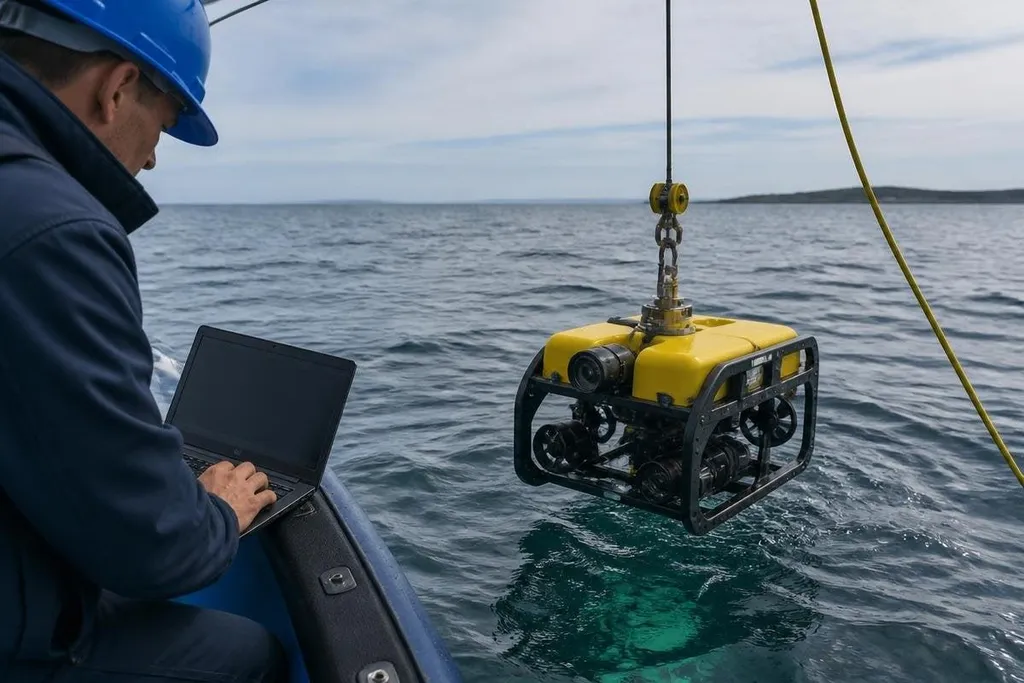
An underwater robot may work 10 m below the surface or operate where radio signals cannot reach it. That changes the design problem: every task depends on power, pressure, sensing, and a clear way back to the surface.
- Longer missions: More work from each battery charge
- Better data: Sensors that still work in dark, cloudy water
- Safer recovery: A clear plan when the robot loses contact
The hard part starts below the surface
Water blocks radio signals over short distances, so many underwater robots use an acoustic modem. It sends data through sound, but the link carries less information and may take longer than a radio connection.
That delay changes how people control the robot. An operator may send a route, wait for the robot to report its position, and then change the next task. A live video feed cannot always be the main control method.
The robot also needs sensors that can measure distance and position without relying on satellite signals.
Cameras help in clear water. Sonar can show objects when light is weak, but its images are harder to read and may have less detail.
Autonomy has to earn its place
An autonomous underwater vehicle, or AUV, follows a planned route without a person steering each movement. It may use sonar, depth sensors, an inertial measurement unit, and software that estimates its position as it moves.
That software needs to deal with currents, changing depth, poor visibility, and gaps in sensor data. A route that works in a tank may need changes in open water, where the robot cannot rely on fixed walls or marked floors.
The useful step is narrow autonomy. A robot can hold its depth, follow a survey line, avoid a known obstacle, or return to a planned recovery point. Each task has a clear result that engineers can check.
A broad claim about full autonomy is harder to trust without field records, failure data, and the conditions of each test. I’d judge an underwater robot by its recovery plan before its video demo.
Power sets the working time
A battery powers movement, sensors, computing, and the acoustic link. More battery mass can add working time, but it also changes buoyancy and makes the robot harder to move through water.
That trade-off gives underwater designers fewer easy answers than they have on land. A slower vehicle may use less power, while a faster one can cover more ground in the same period. The right choice depends on the job and the distance to the recovery point.
Energy use also affects the data plan. High-resolution sonar and image processing can consume power, so the robot may need to store raw data and send only a small status report during the mission.
A dated report on an underwater robot from Robot 24 can tie its power draw to the sensor load, mission date, and control method. Those details matter when a person must decide whether to keep the robot moving, save the data, or bring it back.
The robot still needs a human plan
An underwater robot can collect data without a person beside it, but people still set the task, check the results, and decide what happens after a fault. That work includes launch, recovery, battery handling, software checks, and review of the recorded data.
The recovery plan deserves the same care as the mission route. A robot may lose its acoustic link, meet a current stronger than expected, or stop making useful measurements. Engineers need a way to locate it, raise it, or make it return without creating a second problem.
For an industry buyer, the machine is only one part of the cost. Support equipment, trained staff, vessel time, data review, and repeat missions all affect the result.
A buying checklist
Use these points before choosing an underwater robot for a real job:
- Define the work area: Record depth, distance, current, water clarity, and the time available for each mission.
- Check the link: Ask what the robot can report during a mission and what happens when contact stops.
- Match sensors to the water: Use cameras where light and visibility allow it; use sonar when they do not.
- Measure the full power load: Include movement, sensing, computing, communication, and the return trip.
- Read the recovery steps: Look for a tested method to find and retrieve the robot after a fault.
- Ask for field records: Request mission logs that show conditions, failures, repairs, and data quality.
The next useful underwater robot will be the one that gives its operator a clear job, a known working time, and a safe way home. Until makers publish those figures from real water, buyers should treat autonomy claims as plans to check, not proof.